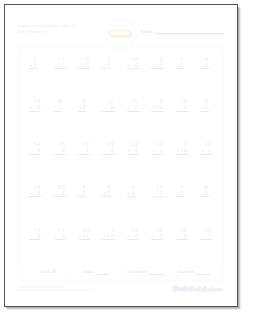
Addition and subtraction within 20 worksheets with an answer key, made to order. Every sum, or every starting number in subtraction, stays at or below the limit you choose: 5, 10, 12, 18 or 20. Make addition sheets, subtraction sheets or a mix, set in columns like the timed tests or written across the line.
Start fromChanges cleared · Edited ·
Facts to 20
Fact strategies
Addition
Bigger addition
Subtraction
Across zeros
Mixed
Missing numbers
Decimals
Addition within 10. Sums up to 10, set in columns.Addition within 20. Sums up to 20, set in columns.Subtraction within 10. Starting numbers up to 10.Subtraction within 20. Starting numbers up to 20.Addition and subtraction within 20. Both operations on one sheet. Watch the signs.Adding three numbers. Three one-digit numbers across the line.Adding 9. Every problem adds 9, sums up to 20.Doubles. Doubles facts up to 10 + 10.Make 10. Find the number that makes 10.Two-digit plus one-digit addition. A two-digit number and a one-digit number.Two-digit addition, no regrouping. No column adds to ten or more.Two-digit addition. Two-digit numbers, regrouping as it comes.Two-digit addition with regrouping. Every problem regroups at least once.Two-digit addition, regrouping in every column. The ones and the tens both regroup.Three-digit plus two-digit addition. A three-digit and a two-digit number.Regrouping in the tens. Three-digit addition that regroups in the tens only.Three-digit addition with regrouping. Every problem regroups at least once.Four-digit addition with regrouping. Four-digit numbers, regrouping at least once.Column addition: four numbers. Four two-digit numbers in a column.Two-digit subtraction, no borrowing. Each top digit is the larger.Two-digit subtraction. Two-digit numbers, the larger on top.Three-digit subtraction, no zeros to cross. Each problem borrows; no zero in the way.Four-digit subtraction. Four-digit numbers, the larger on top.Subtracting across a zero. Three-digit numbers with a zero to work across.Subtracting across two zeros. Four-digit numbers like 5,002 − 1,348.Subtracting from round numbers. Starting from whole hundreds, like 600 − 89.Three-number subtraction. Take two numbers away, one after the other.Two-digit addition and subtraction. Both operations on one sheet. Watch the signs.Three-digit addition and subtraction. Three-digit numbers, both operations.Missing addends within 20. Find the number that completes each sum.Two-digit missing addends. Two-digit sums with one addend hidden.Missing numbers, adding and subtracting. Any number can be the missing one, within 20.Missing digits. Find the hidden digits in each problem.Adding decimals: tenths. Tenths with up to two whole digits.Adding decimals: hundredths. Hundredths, the points lined up.Subtracting decimals: hundredths. Hundredths, the larger number on top.Adding and subtracting decimals. Tenths and hundredths together, both operations.Line up the decimal points. Copy each problem into the grid, then solve.
Make your own addition and subtraction within 20 worksheet
Title and instructions
Left empty, the sheet is titled "Addition and Subtraction Within 20".
40 problems · addition and subtraction within 20 · key shows regrouping · score box · 8 columns · with answer key · name line · border · logo
Print at 100% or Actual size — not “Fit to page”, which shrinks the sheet and makes the measurements wrong.
40 problems · addition and subtraction within 20 · key shows regrouping · score box · 8 columns · with answer key · name line · border · logoUS Letter · print at 100%
Facts within 10 come first, then facts within 20. There are 66 addition facts with sums up to 10 when 0 is allowed, and 231 with sums up to 20, so a sheet of 40 is a fresh sample every time. Turn off Allow 0 once students no longer need the + 0 and − 0 facts.
Doubles, Making 10 and One Number at a Time
Fact practice narrows a sheet to one strategy: doubles (6 + 6), near doubles (6 + 7), or making 10 (7 + □ = 10). Practise one number puts the same number in every problem, such as all the +9 facts, which is how many classes work through the facts one family at a time.
Mixed Sheets
A mixed sheet holds equal numbers of addition and subtraction problems in shuffled order, so students have to read each sign. It is good practice once both operations are familiar, and the answer key keeps marking quick.