Improper Fractions to Mixed Numbers Worksheets
Worksheets for converting improper fractions to mixed numbers, and mixed numbers back to improper fractions, each with an answer key that shows the working. The sheet below turns improper fractions like 19/4 into mixed numbers like 4 3/4. Switch Kind of sheet to Mixed numbers to improper fractions for the reverse.
Improper fractions to mixed numbers. Divide, then put the remainder over the denominator.
Customize this worksheet
Title and instructions
The page
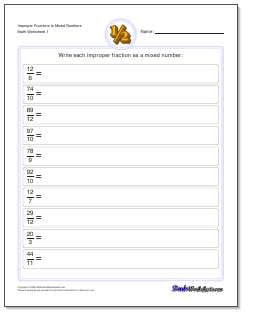
Improper fractions to mixed numbers · denominators 2–12 · whole numbers 1–9 · 10 problems · with worked answer key · name line · border · logo
Print at 100% or Actual size — not “Fit to page”, which shrinks the sheet and makes the measurements wrong.
Improper Fraction to Mixed Number
Divide the numerator by the denominator. The quotient is the whole number, and the remainder goes over the same denominator. For 19/4, 19 ÷ 4 is 4 remainder 3, so 19/4 = 4 3/4.
If the remainder's fraction can be reduced, reduce it: 15/6 is 2 remainder 3, which is 2 3/6, and 3/6 reduces to 1/2, giving 2 1/2. If there is no remainder, the answer is a whole number: 20/4 = 5. The answer keys show each of these steps, so a wrong answer can be traced to the step where it went wrong.
Mixed Number to Improper Fraction
Multiply the whole number by the denominator, add the numerator, and keep the same denominator. For 3 2/5, 3 × 5 = 15, plus 2 is 17, so 3 2/5 = 17/5. This is the first step of adding, subtracting, multiplying or dividing mixed numbers, which is why it is worth practicing on its own.
Choosing the Numbers
The denominators can be a range or a chosen set, such as halves, quarters and eighths. The whole numbers can be kept small for a first sheet or taken up to 20. Ask for several versions to give each student a different sheet, each with its own answer key.
Where to Go Next
To check an answer, the mixed number calculator shows these conversions step by step. For more practice with fractions in lowest terms, see reducing fractions, and for the full set of fraction topics see fractions worksheets.
Print at 100% or Actual Size rather than "Fit to Page".

Copyright 2008-2026 DadsWorksheets, LLC
As an Amazon Associate, I earn from qualifying purchases.


- Copy paper
- #2 pencils
- Big pink erasers