Adding and Subtracting Money Worksheets
Adding and subtracting money worksheets with an answer key, made to order. Every problem is written in dollars and cents and stacked so the decimal points line up, the way students learn to add and subtract money by hand. Choose adding, subtracting or a mix of both, how large the amounts are, whether problems need regrouping, and print.
Adding and subtracting money. Mixed problems under $10.00. Watch the signs.
Make your own adding and subtracting money worksheet
Title and instructions
The page
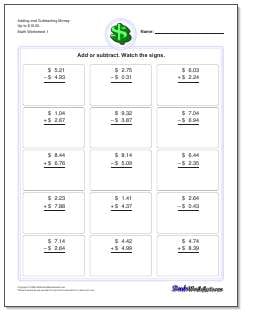
15 add and subtract money problems · up to $10.00 · 3 columns · with answer key · name line · border · logo
Print at 100% or Actual size — not “Fit to page”, which shrinks the sheet and makes the measurements wrong.
Lining Up the Decimal Points
Adding money works like adding whole numbers, with the decimal point keeping dollars and cents apart. The one rule that matters is to line the amounts up on the decimal point, so cents sit over cents and dollars over dollars. Every problem on these sheets is printed that way, with the dollar sign at the left of each line, so students practice reading the columns correctly before they have to set problems up themselves.
Regrouping Cents into Dollars
When the cents add up to 100 or more, they make another dollar. In $3.75 + $1.50 the cents make $1.25, so a dollar is carried into the dollars column and the answer is $5.25. Subtraction works the other way: in $5.50 − $1.75, 75¢ cannot come out of 50¢, so one dollar is broken into 100 cents first, and the answer is $3.75. Set Regrouping to Never for sheets with no carrying or borrowing, or to Always for practice on exactly that step.
Checking Subtraction by Adding
A subtraction answer can always be checked by adding it back. If $8.20 − $3.45 = $4.75, then $4.75 + $3.45 should give $8.20 again. The mixed sheets put addition and subtraction side by side, so students have to watch each sign and can check one kind of problem with the other.
For counting coins and bills, making change and the rest of the money practice, see the Money Worksheets page.

Copyright 2008-2026 DadsWorksheets, LLC
As an Amazon Associate, I earn from qualifying purchases.


- Copy paper
- #2 pencils
- Big pink erasers