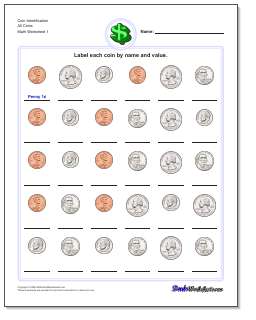
These worksheets allow kids to practice coin identification using realistic images of the four most common US coins (quarters, dimes, nickels and pennies). Each printable PDF worksheet includes an answer key.
Name the coins. Write each coin’s name and value.Match the coins. Draw a line from each coin to its name and value.Heads or tails. Name each coin from its front or its back.Count pennies and nickels. Totals under 50¢, up to 6 coins.Count pennies, nickels and dimes. Totals up to $1.00.Count the coins. Quarters, dimes, nickels and pennies, up to $1.00.Count mixed-up coins. The four coins in any order, up to $1.00.Count coins over a dollar. Totals from $1.01 to $2.00, up to 10 coins.Count coins and bills to $10. Coins with $1 and $5 bills.Count coins and bills to $20. Coins with $1, $5 and $10 bills.Count the bills. $1, $5, $10 and $20 bills, up to $100.00.Make the amount. Write how many of each coin, using the fewest.Draw the coins. Draw the fewest coins that make each amount.Find the missing coin. Which coin makes the total?Change from $1. Prices under $1.00, paid with a dollar.Change from $5. Prices under $5.00, change in coins and $1 bills.Change from $20. Count up from the price to $20.00.Pay with the money shown. Count the money paid, then find the change.Money left. You have $1.00 and spend some. How much is left?Compare the money. Greater than, less than or equal, up to $1.00.Put amounts in order. Four amounts under $5.00, least to greatest.Next dollar up. How many dollars to pay for each price, up to $10.00.Is there enough money?. Coins and $1 bills against a price. Circle yes or no.Adding money. Two amounts under $10.00, lined up on the decimal point.Subtracting money. Amounts under $10.00, the larger amount on top.Adding and subtracting money. Mixed problems under $10.00. Watch the signs.
Make your own coin identification worksheet
Title and instructions
Left empty, the sheet is titled "Coin Identification — All Coins", as the printed money sheets are.
The page
These settings allow 4 different problems, so some repeat.
The worksheets on this page focus on a students ability to differentiate between various US denomination coins and their corresponding monetary values. This is purely a memorization process, but it can be confusing for students at times because of the conflicting visual cues that some coins imply. A common issue is that a student will assume a dime has a smaller monetary value because the coin itself is smaller than either a nickel or a penny. Because of this, it's worth emphasizing frequently that the size of a coin does not correspond to its value, a message confounded by the quarter which is clearly the largest diameter coin as well as the common coin with the largest value.
These practice worksheets are a good first step for young students in Kindergarten or first grade. Even though more advanced monetary concepts aren't introduced as part of Common Core until second grade (CCSS.MATH.CONTENT.2.MD.C.8), early preparation of these skills is essential to being ready for that topic.
Because money is something that students encounter routinely, their curiosity about this subject makes for a great early introduction to math and learning to recognize coins is a great activity even for very young kids.