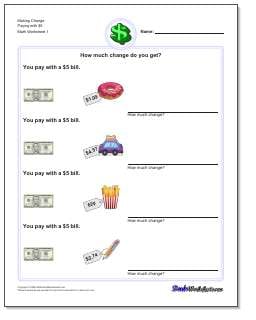
These worksheets allow kids to practice making change from a starting amount of money. There are worksheets that start with change from one dollar, progressing to change from whole dollars, and end with making change from dollars and cents.
Change from $1. Prices under $1.00, paid with a dollar.Change from $5. Prices under $5.00, change in coins and $1 bills.Change from $20. Count up from the price to $20.00.Pay with the money shown. Count the money paid, then find the change.Money left. You have $1.00 and spend some. How much is left?Count pennies and nickels. Totals under 50¢, up to 6 coins.Count pennies, nickels and dimes. Totals up to $1.00.Count the coins. Quarters, dimes, nickels and pennies, up to $1.00.Count mixed-up coins. The four coins in any order, up to $1.00.Count coins over a dollar. Totals from $1.01 to $2.00, up to 10 coins.Count coins and bills to $10. Coins with $1 and $5 bills.Count coins and bills to $20. Coins with $1, $5 and $10 bills.Count the bills. $1, $5, $10 and $20 bills, up to $100.00.Make the amount. Write how many of each coin, using the fewest.Draw the coins. Draw the fewest coins that make each amount.Find the missing coin. Which coin makes the total?Name the coins. Write each coin’s name and value.Match the coins. Draw a line from each coin to its name and value.Compare the money. Greater than, less than or equal, up to $1.00.Put amounts in order. Four amounts under $5.00, least to greatest.Next dollar up. How many dollars to pay for each price, up to $10.00.Is there enough money?. Coins and $1 bills against a price. Circle yes or no.Adding money. Two amounts under $10.00, lined up on the decimal point.Subtracting money. Amounts under $10.00, the larger amount on top.Adding and subtracting money. Mixed problems under $10.00. Watch the signs.
Make your own making change worksheet
Title and instructions
Left empty, the sheet is titled "Making Change — Paying with $5", as the printed money sheets are.
Making change for a purchase is involves a number of complex steps that as adults we do frequently. However for a second grade or third grade student, this requires a number of discrete money skills that can be intimidating. Students need to be prepared not only to determine the decimal value of a collection of currency, but also to subtract from that value to give the resulting change, then count up the bills and coins necessary to give a final representation of the monetary change in a physical form.
This is really the end stage of CCSS.MATH.CONTENT.2.MD.C.8 in the Common Core standard, which is expected to be mastered in second grade. The worksheets on this page present purchase transactions of varying degrees of complexity, but all of which should be easily relatable to a early grade student.
It may be helpful print and cut out the Play Money as a physical aid if students struggle to complete some of these operations mentally.