Simplify Fractions Calculator
Welcome to the Simplify Fractions Calculator
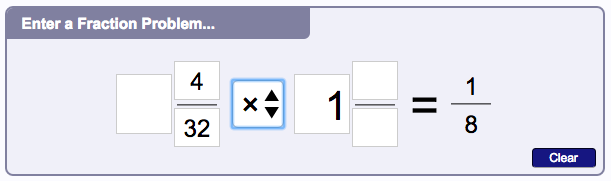
This simplify fractions calculator reduces any fraction to lowest terms and shows how. Type a numerator (the top number) and a denominator (the bottom number), add a whole number if you have a mixed number, and the calculator finds the greatest common factor of the top and bottom, divides both by it, and shows the reduced fraction next to the original as bars drawn on the same scale so you can see that the amount has not changed. It also lists equivalent fractions, writes the value as both an improper fraction and a mixed number, and gives the decimal and percent.
The calculator opens on 18/24, a fraction with several common factors, so the factor lists have something to show. Every conversion gets a link in the “Share This Fraction” panel that reopens the calculator exactly as you left it — handy for sending a worked example to a student. Use the steps to check your reducing, then try the worksheets above for practice without help.
What Does It Mean to Simplify a Fraction?
Simplifying a fraction — also called reducing it, or writing it in lowest terms — means rewriting it with the smallest numerator and denominator that still name the same amount. 18/24 and 3/4 are the same value: cut a pizza into 24 slices and take 18, or cut it into 4 pieces and take 3, and you have eaten exactly the same amount of pizza. The second fraction is simpler because it uses smaller numbers and bigger pieces. A fraction is in simplest form when the only number that divides both the top and the bottom is 1.
Simplifying does not change a fraction’s value, only its appearance. That is why the bars in the calculator’s “Reduce to lowest terms” step line up end to end: 18 of 24 small pieces covers the same length as 3 of 4 large ones. Answers to fraction problems are expected in simplest form, which is why the fraction calculator reduces every result automatically.
How to Find the Greatest Common Factor
The greatest common factor (GCF) of two numbers is the largest number that divides both of them evenly. The most reliable way to find it for homework-sized numbers is to list the factors of each. The factors of 18 are 1, 2, 3, 6, 9 and 18. The factors of 24 are 1, 2, 3, 4, 6, 8, 12 and 24. The numbers on both lists are 1, 2, 3 and 6, and the greatest of those is 6, so GCF(18, 24) = 6. The calculator prints both lists and highlights the shared factors.
For larger numbers the lists get long, so the calculator switches to the Euclidean algorithm: divide the bigger number by the smaller, keep the remainder, then divide the smaller number by that remainder, and repeat until the remainder is 0. The last remainder that was not 0 is the greatest common factor. The factoring calculator lists the factor pairs of any single number, and the prime factorization calculator breaks a number into primes, which is another route to the GCF: multiply the prime factors the two numbers share.
Reduce Fractions to Lowest Terms
Once you have the greatest common factor, reducing is one step: divide the numerator and the denominator by it. For 18/24, divide both by 6: 18 ÷ 6 = 3 and 24 ÷ 6 = 4, so 18/24 = 3/4. Dividing the top and the bottom by the same number keeps the value the same, exactly as multiplying both by the same number does.
If you divide by a common factor that is not the greatest — say 2 instead of 6 — you get 9/12, which is correct but still not in lowest terms, so you would have to reduce again. Using the GCF gets there in one step. A fraction is already in simplest form when its greatest common factor is 1: for 7/9, the factors of 7 are 1 and 7, the factors of 9 are 1, 3 and 9, the only common factor is 1, and there is nothing to reduce. The calculator says so plainly rather than showing a division by 1.
Equivalent Fractions Calculator
Equivalent fractions are different fractions that name the same amount. You make one by multiplying the top and the bottom of a fraction by the same number: 3/4 × 2/2 = 6/8, 3/4 × 3/3 = 9/12, and so on. Reducing is the same process run backwards. This page works as an equivalent fractions calculator too — after reducing your fraction, it lists the first five fractions equivalent to the answer: for 3/4 they are 6/8, 9/12, 12/16, 15/20 and 18/24, and your original fraction is on that list if it was not already in lowest terms.
Equivalent fractions matter most when you add or subtract: two fractions need the same denominator (the bottom number) before their tops can be combined, and the way to get there is to rewrite each one as an equivalent fraction over a common denominator. The fraction chart shows halves through sixteenths lined up so equivalents like 1/2, 2/4, 4/8 and 8/16 sit directly on top of each other.
Improper Fraction Calculator
An improper fraction has a numerator larger than its denominator, like 22/8 — more than one whole. It is a perfectly good fraction, but answers are usually written as mixed numbers, so this page doubles as an improper fraction calculator. First reduce: 22/8 has a greatest common factor of 2, so it becomes 11/4. Then divide the numerator by the denominator: 4 goes into 11 two times (8) with 3 left over, so 11/4 = 2 3/4. The calculator shows this split as 8/4 + 3/4 in its “Write it as a mixed number” step.
Going the other way — mixed number to improper fraction — multiply the whole number by the denominator and add the numerator, keeping the denominator: 2 3/4 is 2 × 4 + 3 = 11 over 4, or 11/4. Both forms are shown in the answer panel so you can use whichever your assignment asks for. A fraction that divides out exactly, like 12/4, is simply the whole number 3.
Simplifying Mixed Numbers
To simplify a mixed number, reduce its fraction part; the whole number stays as it is. 2 6/8 becomes 2 3/4 because 6/8 reduces to 3/4. The calculator takes a slightly longer route that also produces the improper form: it converts 2 6/8 to 22/8, reduces that to 11/4, and then writes 11/4 back as 2 3/4. Type the whole number in the large box, the numerator and denominator in the smaller boxes, and both the simplified mixed number and its improper fraction appear in the answer panel.
Negative fractions reduce exactly like positive ones, with the sign carried along: −6/8 is −3/4. Use the sign button beside the inputs to make a fraction negative, and write the minus sign once, in front of the whole fraction, never on both the top and the bottom.
Further Reading on Simplifying Fractions
- The visual fraction calculator reduces every answer automatically and shows the reduction as one of its worked steps.
- The mixed number calculator covers adding, subtracting, multiplying and dividing mixed numbers, with the conversions to and from improper fractions worked out.
- Greatest common divisor at Wikipedia — the Euclidean algorithm in full, with its history.
Simplify Fractions Calculator Updates
| Date | Description |
|---|---|
| 09/05/2026 | First release. Reduces any fraction with the greatest common factor shown from factor lists or the Euclidean algorithm, draws the original and reduced fractions on one scale, lists equivalent fractions, and shows improper and mixed number forms. |

Copyright 2008-2026 DadsWorksheets, LLC
As an Amazon Associate, I earn from qualifying purchases.



- Copy paper
- #2 pencils
- Big pink erasers