Skip Counting Worksheets
Skip counting worksheets with an answer key, made to order. Each row counts by the same step with some boxes left blank. Count by 2s, 3s, 4s, 5s, 10s, 25s or 100s, forward or back, starting wherever you like.
Skip counting by 5s. Fill in the missing numbers in each row.
Make your own skip counting worksheet
Title and instructions
The page
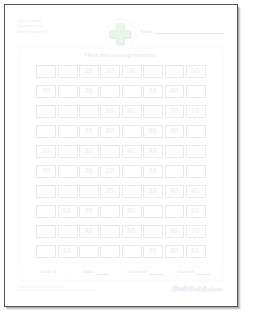
10 rows · skip counting · counting by 5s · 8 boxes a row · score box · with answer key · name line · border · logo
Print at 100% or Actual size — not “Fit to page”, which shrinks the sheet and makes the measurements wrong.
Counting by 2s, 5s and 10s
Counting by 10s and 5s comes first, because the numbers end in the same digits every time. Counting by 2s follows, and it is the start of odd and even numbers. Begin with rows that start at a multiple of the step, so 5, 10, 15 looks the way it does on a hundreds chart, then choose Anywhere for rows like 7, 12, 17, where students have to add the step instead of recognizing a pattern.
Counting Back
Set Direction to Back for rows that count down, or Both to mix the two. Counting back by 10s is the first step toward subtracting tens in your head. With the blanks after the first numbers, students see the pattern before they continue it.
Skip Counting and Multiplication
Counting by 3s and 4s is the times tables, one step at a time: the fifth box in a row that counts by 3s from 0 is 4 × 3. A hundreds chart shows the same patterns as columns and diagonals, and the multiplication worksheets take them further.
For the parts that make a number, see Number Bonds Worksheets.

Copyright 2008-2026 DadsWorksheets, LLC
As an Amazon Associate, I earn from qualifying purchases.


- Copy paper
- #2 pencils
- Big pink erasers