Number Bonds Worksheets
Number bonds worksheets with an answer key, made to order. Each bond shows a whole in the top circle and its two parts below. Leave a part or the whole blank, choose numbers to 10, 20 or 100, and add a line for the matching addition sentence.
Number bonds to 10. Find the missing part of each bond.
Make your own number bonds worksheet
Title and instructions
The page
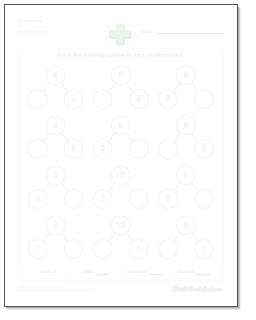
12 number bonds · number bonds · to 10 · score box · 3 columns · with answer key · name line · border · logo
Print at 100% or Actual size — not “Fit to page”, which shrinks the sheet and makes the measurements wrong.
What a Number Bond Is
A number bond shows how a number splits into two parts. The whole goes in the top circle and the parts in the circles below it: 10 splits into 6 and 4, or 7 and 3, or 10 and 0. When one circle is empty, students find it by counting on, by subtracting, or by remembering the pair. Knowing the pairs that make 10 by heart makes adding and subtracting across a ten much easier later.
Bonds to 10, 20 and 100
Start with bonds to 10, with one part missing. When those come quickly, leave the whole blank instead, then move to 20, where every pair to 10 has a partner pair ten higher (6 and 4 make 10, 16 and 4 make 20). Bonds to 100 practise the same idea with tens and ones.
From Number Bonds to Fact Families
Turn on Line for the number sentence and students write the addition that matches each bond. One bond holds four facts: 6 + 4 = 10, 4 + 6 = 10, 10 – 6 = 4 and 10 – 4 = 6. That set is a fact family, and the Fact Family Worksheets page practises all four at once.
For counting patterns, see Skip Counting Worksheets; for more early addition practice, the Addition and Subtraction Within 20 page.

Copyright 2008-2026 DadsWorksheets, LLC
As an Amazon Associate, I earn from qualifying purchases.


- Copy paper
- #2 pencils
- Big pink erasers